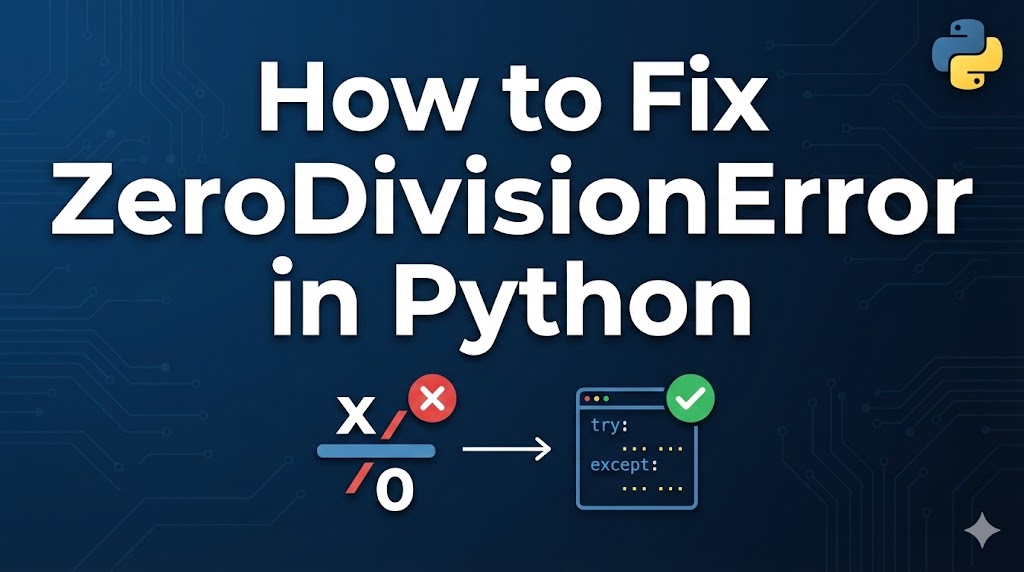
Your Python program just crashed with a ZeroDivisionError: division by zero. It sounds scary, but it’s actually one of the simplest errors to understand and fix.
This error means your code tried to divide a number by zero — which is mathematically impossible. Python stops your program to let you know something went wrong.
Let’s look at why this happens and how to handle it properly.
目次
What Causes a ZeroDivisionError in Python
- Dividing by a variable that happens to be zero — The variable might come from user input, a calculation, or a database, and you didn’t expect it to be zero.
- Using the modulo operator (%) with zero — The
%operator (which gives you the remainder of a division) also fails when the divisor is zero. - Calculating averages with an empty list — Dividing a sum by the count of items when there are no items means dividing by zero.
Fix 1: Check for Zero Before Dividing
The simplest fix is to check if the divisor (the number you’re dividing by) is zero before doing the division.
Example of the error:
# This raises ZeroDivisionError
total = 100
count = 0
average = total / count
Step 1: Add an if statement to check for zero.
total = 100
count = 0

if count != 0:
    average = total / count
    print(f"Average: {average}")
else:
    print("Cannot calculate average: no items to divide by.")
If the program prints the warning message instead of crashing, you’ve fixed it.
Step 2: For user input, validate before calculating.
numerator = float(input("Enter the numerator: "))
denominator = float(input("Enter the denominator: "))

if denominator == 0:
    print("You can't divide by zero. Please enter a non-zero number.")
else:
    result = numerator / denominator
    print(f"Result: {result}")
If the program rejects zero and accepts other numbers, everything is working correctly.
Fix 2: Use try-except to Handle the Error
When you can’t predict whether the divisor will be zero (for example, when it comes from complex calculations or external data), use error handling.
Step 1: Wrap the division in a try-except block.
def safe_divide(a, b):
    try:
        return a / b
    except ZeroDivisionError:
        print("Warning: Division by zero. Returning 0 as default.")
        return 0

# Using the function
result = safe_divide(100, 0)
print(f"Result: {result}")
# Output:
# Warning: Division by zero. Returning 0 as default.
# Result: 0
If the program prints the warning and continues without crashing, it’s working.
Step 2: Use this pattern for calculating averages safely.
scores = []  # An empty list

try:
    average = sum(scores) / len(scores)
    print(f"Average score: {average}")
except ZeroDivisionError:
    print("No scores available to calculate an average.")
Fix 3: Use Default Values or Conditional Expressions
For quick, inline handling, you can use a conditional expression (a short way to write an if-else on one line).
Step 1: Use a conditional expression to provide a default value.
total = 100
count = 0

# If count is 0, use "N/A" instead of dividing
average = total / count if count != 0 else "N/A"
print(f"Average: {average}")  # Output: Average: N/A
If the program shows “N/A” instead of crashing, it’s working correctly.
Step 2: For numerical results, you might want to default to zero.
total = 100
count = 0

# Returns 0 when count is zero
average = total / count if count else 0
print(f"Average: {average}")  # Output: Average: 0
What to Do If It Still Doesn’t Work
- Trace the variable — Add
print(f"divisor = {variable}")before the division to see exactly what value is causing the issue. - Check your data source — If the zero comes from a file, database, or API (a service your code connects to), validate the data when you first load it.
- Review your math logic — Sometimes the zero is a symptom of a bug earlier in your code. Make sure the calculations leading up to the division are correct.
- Use a debugger — In VS Code, set a breakpoint (a pause point) on the line with the division and inspect the variables.
Summary
- A ZeroDivisionError means your code tried to divide by zero, which Python doesn’t allow.
- The simplest fix is to check
if divisor != 0before dividing. - For unpredictable data, wrap the division in a
try-except ZeroDivisionErrorblock.
Related articles:
- valueerror-python.html
- type-error-python.html
- syntax-error-invalid-syntax.html















Leave a Reply