目次
- 1 [¥165 Trillion] Minami-Torishima Rare Earth Mining Begins: The Day Japan Becomes a ‘Resource Superpower’ and Breaks Free from China Dependency
- 1.1 Why Minami-Torishima Now? The Reality of China’s “Resource Weaponization”
- 1.2 ¥165 Trillion in Deep-Sea Resources: 3 Advantages of Minami-Torishima Rare Earth Mud
- 1.3 Challenge at 6,000m Depth: World-First Mining Technology
- 1.3.1 Demonstration Test by Deep Sea Drilling Vessel “Chikyu”
- 1.3.2 Closed-Loop Circulation System: Balancing Environmental Care and Efficiency
- 1.3.3 Submersible Pump + Screw Mud Collection: Efficient Lifting Mechanism
- 1.3.4 Airlift Method: Lifting with Air Buoyancy
- 1.3.5 Lifting Pipe Materials: Why Titanium and Carbon Fiber?
- 1.3.6 Environmental Monitoring System: Surveillance Based on Global Standards
- 1.4 Ripple Effects on the Japanese Economy: Transforming the Industrial Structure
- 1.5 Roadmap to Commercialization in 2028 and Remaining Challenges
- 1.5.1 Commercialization Roadmap
- 1.5.2 On-island Processing Facility: Key to Reducing Transport Costs by 80%
- 1.5.3 Challenge 1: Economic Rationality and “China Risk”
- 1.5.4 Challenge 2: Technical Durability and Continuous Operation
- 1.5.5 Challenge 3: Building a Supply Chain Including Smelting
- 1.5.6 Challenge 4: Environmental Protection and Physical Security
- 1.6 Summary: Rare Earths as a “National Shield”
- 1.7 Frequently Asked Questions (FAQ)
- 1.8 References
[¥165 Trillion] Minami-Torishima Rare Earth Mining Begins: The Day Japan Becomes a ‘Resource Superpower’ and Breaks Free from China Dependency
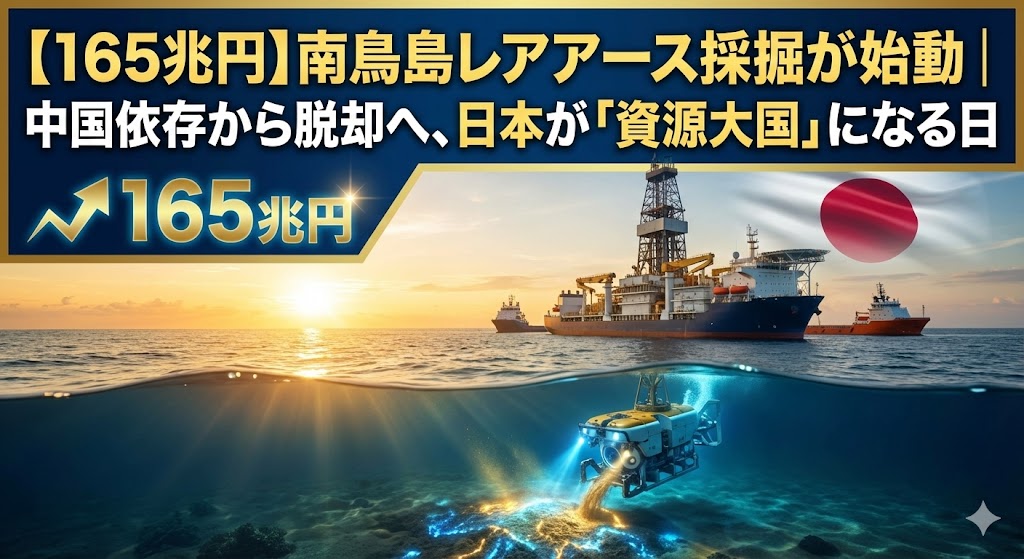
In January 2026, Japan’s energy resource history began to move. The world’s first rare earth mud mining trial commenced at a depth of 6,000m off the coast of Minami-Torishima. The dormant asset value is approximately 165 trillion yen—equivalent to 1.5 times the national budget. As China’s export restrictions shake global industries, can this “deep-sea treasure” be the trump card that transforms Japan from a “resource importer” into a “resource superpower”? We thoroughly explain the full picture of the Minami-Torishima rare earth development, from technological breakthroughs to economic security.
Why Minami-Torishima Now? The Reality of China’s “Resource Weaponization”
The backdrop to the rapid advancement of rare earth development off Minami-Torishima as a national project lies in the pressing international situation of China’s “weaponization of resources.”
Currently, China holds about 70% of global rare earth production and over 90% of refining capacity. Export restrictions utilizing this monopoly status now wield power equivalent to “economic sanctions.”
2025-2026: China’s Export Restrictions Shake the World
In April 2025, the Chinese government tightened export controls on “7 types of medium and heavy rare earths.” This measure had an immediate and immense impact on global industries.
Impact on the US: 16 US defense-related companies were placed on the export control list, threatening the supply of rare earths essential for manufacturing F-35 fighter jets, nuclear submarines, and missiles. The Department of Defense warned this would “invite constraints on the industrial base.” To avoid supply chain disruption, the US was forced to partially shift diplomatic policy, such as postponing the application of tariffs on China.
Impact on Europe: The destabilization of magnet supplies from China caused stock depletion at automotive parts factories across Europe. Production lines and parts of factories were forced to suspend operations.
Impact on Japan: Negative effects on the real economy materialized, such as Suzuki temporarily halting production of its mainstay “Swift” model due to parts shortages. Furthermore, India, which was relied upon as an alternative source, prioritized domestic demand and suspended rare earth export agreements with Japan. Japan fell into a worst-case scenario where procurement routes were doubly blocked.
Nomura Research Institute Estimate: ¥2.6 Trillion Loss from Supply Disruption
According to estimates by the Nomura Research Institute, if rare earth supplies were disrupted for one year, Japan’s GDP could be pushed down by 0.43%, amounting to approximately 2.6 trillion yen. This is not merely an “increase in procurement costs” but a risk involving the very survival of Japan’s key industries, such as the automotive and electronics sectors.
In this context, building a system to self-supply resources within the country’s Exclusive Economic Zone (EEZ) becomes a “trump card” for establishing a resilient supply chain unaffected by foreign policies. The development of rare earths in Minami-Torishima is accelerating precisely due to this demand for economic security.
¥165 Trillion in Deep-Sea Resources: 3 Advantages of Minami-Torishima Rare Earth Mud
“Rare earth mud” spreading at a water depth of about 6,000m off Minami-Torishima possesses revolutionary characteristics not found in conventional land mines. Its advantages are summarized in three points: quantity, quality, and ease of processing.
Advantage 1: Overwhelming Resource Quantity Equal to “Centuries” of Global Demand
The reserves around Minami-Torishima are estimated at approximately 16 million tons, calculated at current market prices to be about 165 trillion yen. This is an astronomical scale, equivalent to about 1.5 times Japan’s general account national budget (approx. 110 trillion yen).
Of particular note is the volume of “heavy rare earths,” which are essential for high-tech products and defense equipment.
| Element Name | Main Uses | Years of Global Demand |
|---|---|---|
| Dysprosium (Dy) | Improving heat resistance of EV motor magnets | Approx. 730 years |
| Yttrium (Y) | Lasers, electronic components | Approx. 780 years |
| Terbium (Tb) | High-performance magnets, defense equipment | Abundant (Details undisclosed) |
If this amount can be secured, Japan could potentially establish a status like a “resource major,” possessing not just self-sufficiency but also a certain degree of pricing power over international rare earth prices.
Advantage 2: Rich in “Heavy Rare Earths” with Low Radioactive Material
Rare earths are categorized into “light rare earths” and “heavy rare earths,” with China monopolizing most of the latter’s supply. A feature of the mud at Minami-Torishima is its extremely high ratio of these heavy rare earths.
Even more important is that it contains almost no radioactive substances like thorium or uranium, which are the biggest issues for land mines (such as in China). Consequently, it is positioned as a “clean resource” that has low environmental impact and can be developed safely.
Advantage 3: Easy Processing & Extraction (No Crushing Required)
Usually, rare earths are mined from hard rock, requiring a “crushing process” to break the rock after mining. However, since the resource at Minami-Torishima is literally “mud,” this process is unnecessary.
Additionally, it has been found that rare earths are concentrated in particles of specific sizes, allowing for easy sorting and concentration using centrifuges. Extraction using dilute hydrochloric acid is also relatively easy, offering physical and chemical advantages that can significantly simplify the smelting process.
Discovery of Manganese Nodules: Another “Treasure Trove”
A 2024 survey revealed that “manganese nodules,” which are battery materials, are also distributed in large quantities in the same sea area, in addition to rare earth mud.
- Cobalt: Approx. 75 years of domestic consumption (approx. 610,000 tons)
- Nickel: Approx. 11 years of domestic consumption (approx. 740,000 tons)
These are densely packed, amounting to about 230 million tons over an area of approximately 10,000 square kilometers. Developing these alongside rare earths holds the potential to fundamentally support the supply chain of Japan’s battery industry.
Challenge at 6,000m Depth: World-First Mining Technology
A depth of 6,000m is an extreme environment with water pressure sufficient to crush a small car on a fingertip (approx. 600 atmospheres). To lift mud from this depth—equivalent to about 10 Tokyo Skytrees stacked—Japan is deploying proprietary cutting-edge technology.
Demonstration Test by Deep Sea Drilling Vessel “Chikyu”
From January 12 to February 14, 2026 (planned), the Japan Agency for Marine-Earth Science and Technology (JAMSTEC)’s deep-sea drilling vessel “Chikyu” is conducting performance tests of the rare earth mud mining system off Minami-Torishima. This is a national project led by the Cabinet Office’s Strategic Innovation Promotion Program (SIP).
Closed-Loop Circulation System: Balancing Environmental Care and Efficiency
The core technology adopted for this test is the “Closed-loop Circulation Method,” an evolution of the “mud circulation method” used in oil and natural gas drilling, adapted for deep-sea mining.
Mechanism: The ship on the surface and the mining machine on the seabed are connected by “down” and “up” pipes, circulating mud in a completely closed system. This prevents turbidity (plumes) and harmful substances generated during mining from leaking into the surrounding seawater, minimizing the impact on the deep-sea ecosystem.
Submersible Pump + Screw Mud Collection: Efficient Lifting Mechanism
To efficiently suck up seabed mud, an integrated system of “submersible pump + screw mud collection” has been adopted.
- Screw Mud Collection: A screw mounted on the mining machine agitates the high-viscosity mud, mixing it with seawater to adjust it into a fluid (slurry) of appropriate concentration.
- Lifting via Submersible Pump: Utilizing high-output submersible motors and pumps that operate under ultra-high pressure of 600 atmospheres, the mud is transported stably and with low energy to the surface.
Airlift Method: Lifting with Air Buoyancy
The “Airlift Method” is used supplementarily. It involves sending compressed air into a long pipe and using the lifting force of rising bubbles to pull up the mud water. Imagine the same principle as an aquarium bubbler, but on a massive scale at 6,000m depth.
Since the main machinery (compressor) is on the ship and only pipes without drive parts are underwater, it has the advantage of being less prone to failure and highly maintainable.
However, bubbles injected at 6,000m depth expand approximately 600 times in volume upon reaching the surface. Advanced technology is required to control this rapid expansion and prevent mud clogging or pipe rupture.
Lifting Pipe Materials: Why Titanium and Carbon Fiber?
For the pipe (lifting pipe) lowered to 6,000m, titanium alloys and Carbon Fiber Reinforced Plastics (CFRP) are adopted instead of conventional steel. There are two reasons for this.
Prevention of Resonance: With steel pipes, as the depth increases, the total weight of the pipe increases, and its “natural frequency” approaches the frequency of the ship’s pitching (vertical rocking). If the frequencies match, “resonance” occurs, increasing the risk of the pipe snapping. Using lightweight materials shifts the natural frequency to a band that doesn’t clash with the ship’s motion, preventing breakage.
Weight Reduction: A pipe 6,000m long is subjected to an enormous load from its own weight alone. Using lightweight, high-strength materials prevents the pipe from tearing under its own weight.
Environmental Monitoring System: Surveillance Based on Global Standards
To minimize the impact of mining on the deep-sea ecosystem, constant monitoring is conducted using the following latest equipment.
- Seafloor Observation Device “Edokko No. 1”: An improved version (COEDO) specialized for operation with “Chikyu” is adopted to record the seabed situation during mining operations via video and data.
- Environmental DNA Automatic Sampling Device: Analyzes underwater DNA to comprehensively understand what organisms live there and in what quantities.
- Hydrophone (Underwater Microphone): Monitors operating sounds emitted by the mining machine and ambient environmental sounds to evaluate the acoustic impact on the ecosystem.
- ROV (Remotely Operated Vehicle): Moves around the deep sea via remote control from the ship to visually confirm the state of the mining machine and the surrounding environment.
Monitoring is conducted based on International Standards (ISO) published by the Cabinet Office SIP, aiming to make Japan’s proprietary environmental care technologies the “global rule (standard).”
Ripple Effects on the Japanese Economy: Transforming the Industrial Structure
The figure of 165 trillion yen represents more than just the value of reserves. If this asset is actually developed, it will bring multi-layered impacts to the Japanese economy: not only “wealth creation on a national budget scale” but also “industrial structure transformation” and the “elimination of economic security risks.”
Structural Shift from “Resource-Poor” to “Resource Superpower”
If rare earths from Minami-Torishima are supplied to the market, Japan has the potential to transform from a resource importer to a “resource exporter.” The scale of 730 years’ worth of Dysprosium and 780 years’ worth of Yttrium suggests Japan could establish a status like a “resource major” with pricing power over international rare earth prices, dramatically improving its trade balance.
Trillions of yen in import payments that previously flowed overseas (mainly to China) would remain domestically, circulating within domestic industries.
Ripple Effects on Industry
Rare earth mud development will bring special demand to a wide range of industries, from mining to smelting, processing, and final products.
Creation of New Industries: Mining technology from 6,000m depths and the construction of offshore plants are expected to bring a new market worth trillions of yen to Japan’s shipbuilding, marine civil engineering, and robotics industries.
Strengthening Manufacturing Cost Competitiveness: If cheap and stable domestic rare earths are supplied, manufacturing costs for automobiles (EV motors), wind power generation, and electronics industries will drop, dramatically improving international competitiveness.
Revival of the Smelting Industry: By bringing the “smelting” process—currently over 90% controlled by China—back domestically, high-value-added material industries could be revitalized within Japan.
“Loss Avoidance” Effects on Economic Security
There is a huge economic effect not only in the positive aspect of “making money” but also in the risk avoidance aspect of “not losing money.”
Avoidance of GDP Loss: Considering the aforementioned estimate by Nomura Research Institute (approx. 2.6 trillion yen GDP loss from supply disruption), securing domestic resources becomes the “ultimate insurance” to prevent this potential economic loss.
Improvement of Negotiating Power Against China: Holding the card of “being able to mine domestically” nullifies economic coercion such as export restrictions by China and strengthens Japan’s position in diplomatic and trade negotiations.
Roadmap to Commercialization in 2028 and Remaining Challenges
The government aims for commercialization from 2028 onwards, but several high hurdles must be cleared to establish this as an independent “industry” after successful experiments.
Commercialization Roadmap
| Period | Plan Content | Details |
|---|---|---|
| Jan-Feb 2026 | Mining & Lifting Demonstration Test | World’s first demonstration test using “Chikyu” to confirm if lifting mud from 6,000m depth is possible. |
| During FY2026 | Design of On-island Processing Facility | Preparations for constructing an ore dressing and dehydration facility on Minami-Torishima to reduce transport costs. |
| 2027 | Large-scale Pilot Test | Full-scale mining test recovering rare earth mud on a scale of 350 tons per day. |
| From 2028 | Commercialization & Social Implementation | Encouraging private sector entry and aiming to transition to a commercial production system. |
| Around 2030 | Full-scale Commercial Mining | Economic analysts predict that substantial commercial mining will be realized around this time. |
On-island Processing Facility: Key to Reducing Transport Costs by 80%
The biggest barrier to commercialization is transport cost. Minami-Torishima is about 1,900km from Tokyo, and transporting mud with high water content as-is would not be profitable.
Therefore, a plan is underway to build a processing facility on Minami-Torishima to perform ore dressing and dehydration locally, reducing transport volume by about 80% (volume reduction) before shipping to the mainland. Since rare earths are concentrated in particles of specific sizes, efficient concentration using centrifuges is possible.
Challenge 1: Economic Rationality and “China Risk”
Being technically able to mine is different from being profitable as a business. Mining from 6,000m depth incurs enormous costs compared to land mines. Operating a vessel like the “Chikyu” is said to cost over ten billion yen annually.
The biggest risk is that as soon as Japan begins commercial production, China, which holds the majority share, could intentionally crash rare earth prices (dumping) to drive Japan’s mining business into the red and crush it. To counter this, support systems considering security costs, such as government “purchase guarantees,” “subsidies,” or a joint Japan-US stockpiling framework, are considered essential.
Challenge 2: Technical Durability and Continuous Operation
Tests in 2026 and 2027 are short-term (about one month), but commercialization requires stable operation on a yearly basis. Fluids containing mud and sand are highly abrasive, severely wearing down lifting pipes, submersible pumps, and motors. Establishing systems that can withstand long-term continuous operation or be replaced quickly at low cost is a technical focal point.
Challenge 3: Building a Supply Chain Including Smelting
“Mining” alone does not create products. It is necessary to establish “smelting and processing” steps to extract rare earths from the mined mud and process them into magnets, etc. Currently, China controls over 90% of rare earth smelting (separation and refining) capacity. Unless this smelting infrastructure is built within Japan, we would end up sending mud to China for processing, failing to achieve independence.
Challenge 4: Environmental Protection and Physical Security
Much of the impact on deep-sea ecosystems remains unknown. To avoid inviting international criticism, it is necessary to continue proving the effectiveness of the closed-loop circulation system and ensure consistency with international rules (such as ISA regulations).
Also, as the resource value increases, there are reports of increased activity by Chinese naval vessels around Minami-Torishima. Establishing a “maritime security system” to protect mining platforms and transport ships from physical obstruction or intimidation is also urgent.
Summary: Rare Earths as a “National Shield”
The rare earth mud of Minami-Torishima is not merely a mineral resource. It is an entity that can serve as a “national shield” to protect Japan’s industrial competitiveness and security.
Considering the asset value of 165 trillion yen, reserves equivalent to hundreds of years of global demand, and the strategic significance of breaking away from China dependency, it is no exaggeration to say that the demonstration test started in January 2026 is the biggest turning point in Japan’s resource energy history.
Of course, many challenges remain before commercialization, such as ensuring economic rationality, building smelting infrastructure, and addressing international rules. However, if commercialization is realized from 2028 onwards, Japan will undergo a paradigm shift from a “resource buying country” to a “resource selling country.”
How will the “treasure trove” sleeping at 6,000m depth change Japan’s future? That answer is being written right now off the coast of Minami-Torishima.
Frequently Asked Questions (FAQ)
Q. How large are the rare earth reserves at Minami-Torishima?
A. It is estimated that approximately 16 million tons of rare earth oxides exist within the EEZ around Minami-Torishima. The economic value is about 165 trillion yen, equivalent to roughly 1.5 times Japan’s national budget. It is estimated to contain 730 years’ worth of Dysprosium and 780 years’ worth of Yttrium for global demand.
Q. When is commercialization expected?
A. The government aims for commercialization from 2028 onwards. The plan involves demonstration tests using “Chikyu” starting in January 2026, followed by full-scale mining trials of 350 tons per day in 2027, transitioning gradually to commercial production. Some experts predict substantial commercial mining around 2030.
Q. Why is dependency on China a problem?
A. Currently, China controls about 70% of global rare earth production and over 90% of refining capacity. Due to export restrictions in 2025, serious impacts emerged, such as production halts in Japan’s automotive industry (e.g., Suzuki “Swift”) and the global defense industry. Nomura Research Institute estimates that a one-year supply disruption could depress GDP by approximately 2.6 trillion yen.
Q. Is the environmental impact okay?
A. Japan has adopted a proprietary technology called the “Closed-loop Circulation System” to prevent turbidity (plumes) during mining from spreading to the surroundings. Also, constant monitoring is conducted using “Edokko No. 1” and environmental DNA automatic sampling devices, carrying out environmental assessments based on International Standards (ISO).
Q. What happens to the mud after mining?
A. The residual mud after extracting rare earths is planned to be neutralized and detoxified, then reused as cement material, concrete aggregate, landfill material, soil improver, etc. The goal is an environmentally harmonious development model that uses up the resource rather than simply disposing of it.







Leave a Reply