目次
- 1 [2026 Update] Minami-Torishima Rare Earth Development: Strategic Guide to 15 Japanese & U.S. Stocks
[2026 Update] Minami-Torishima Rare Earth Development: Strategic Guide to 15 Japanese & U.S. Stocks
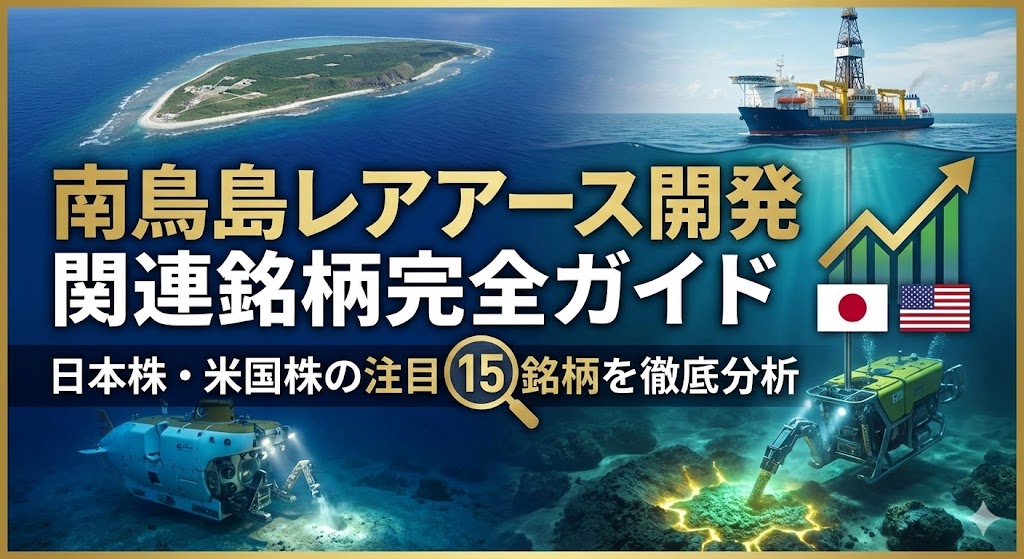
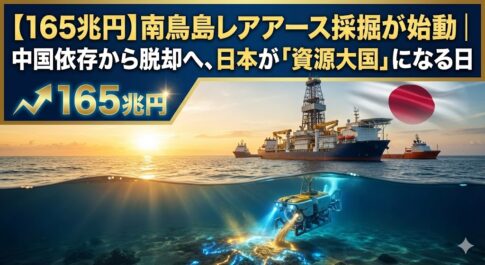
In January 2026, the world’s first 6,000m deep-sea mining trial commenced, signaling a massive shift in Japan’s national resource strategy. The Minami-Torishima Exclusive Economic Zone (EEZ) holds an estimated 16 million tons of Rare Earth Elements (REE) mud. This “mega-find” is a cornerstone for Japan’s goal to decouple from Chinese supply chains. This report provides a fundamental and technical analysis of the Japan-U.S. stocks poised to benefit from this tectonic shift in economic security.
*This article is for informational purposes only and does not constitute investment advice. Please conduct your own due diligence.
Project Status: 2026 as the Watershed Year
On January 11, 2026, JAMSTEC’s research vessel “Chikyu” departed for the waters off Minami-Torishima, 1,950km from Tokyo. The mission: the world’s first large-scale connection test to extract REE mud from the seabed at a depth of 6,000 meters. Operating under 600 atmospheres of pressure, this trial is a critical proof-of-concept for deep-sea mining technology.
Vast Reserves and Exceptional Grade
The target area holds dysprosium sufficient for 730 years and terbium for 420 years of global demand. Most notably, the ore grade is approximately 20 times higher (5,000-8,000ppm) than Chinese land-based mines. Furthermore, it is a “clean” resource with minimal radioactive elements.
Commercialization Timeline
| Timeline | Milestone | Significance for Investors |
|---|---|---|
| Jan-Feb 2026 | Connection Tests (Ongoing) | Short-term catalyst for tech providers upon success. |
| Feb 2027 | 350 ton/day Large-scale Mining Trial | Validation of commercial viability. |
| FY2027 | Processing Facility Completion | Benefits shift to infrastructure and logistics firms. |
| FY2028+ | Commercial Production Launch | End-users (EV, Magnets, Defense) become primary beneficiaries. |
The Japanese government has invested approx. 40 billion JPY via the SIP program since 2018, with an additional 16.4 billion JPY allocated in the 2025 supplementary budget, underscoring the “national project” status.
Japanese Stocks: Marine Development & Shipbuilding
MODEC, Inc. [6269.T] — Top Pick
| Metric | Value | Assessment |
|---|---|---|
| Stock Price | 15,000 JPY | +366% YoY |
| Market Cap | ~1.02 Trillion JPY | Large-cap |
| Forward PER | 20.8x | Reasonable for growth |
| PBR (Actual) | 5.43x | Slightly elevated |
| ROE | 21.29% | High efficiency |
Performance is explosive. Q3 2025 revenue hit $3.35B (+11.9% YoY) with operating profit at $305M (+19.5% YoY). Order backlog reached a staggering $8.47B (+1,327% YoY). As a world leader in FPSO technology, MODEC is the “purest play” for transferring deep-sea oil/gas tech to REE extraction.
Mitsubishi Heavy Industries [7011.T]
Market Cap: ~15.2 Trillion JPY. A titan in defense, space, and nuclear power. MHI owns Nagasaki Shipyard and holds core tech for seabed resource exploration. While a massive conglomerate, its role in the “Chikyu” vessel and subsea robotics makes it a staple for any Japan-themed economic security portfolio.
Kawasaki Heavy Industries [7012.T]
KHI is a pioneer in AUV (Autonomous Underwater Vehicles) and submarines. Their expertise in high-pressure subsea systems is indispensable for the Minami-Torishima project. Currently viewed as undervalued by several analysts with a target price of 18,812 JPY.
Japanese Stocks: Materials, Magnets & Trading Houses
Shin-Etsu Chemical [4063.T]
The world’s top rare earth magnet manufacturer. With a 10.18 Trillion JPY market cap, it offers stability and a 2.07% dividend yield. Shin-Etsu is the most likely primary beneficiary of a stable domestic REE supply for high-end industrial magnets.
TDK Corporation [6762.T]
TDK has successfully mass-produced “heavy rare-earth-free” neodymium magnets. This dual strategy—reducing dependency while securing supply—makes them a resilient pick against REE price volatility.
Trading Houses (Sogo Shosha)
- Mitsubishi Corp [8058.T]: Trading at 12x PER, offering resource procurement depth.
- Sumitomo Corp [8053.T]: Holds exclusive distribution rights with U.S.-based MP Materials.
- Sojitz [2768.T]: An early investor in Australia’s Lynas, the world’s largest non-Chinese REE producer.
U.S. Stocks: Mining, Defense & Deep-sea Tech
MP Materials [MP] — The Western Anchor
Operating the only REE mine in the Western Hemisphere (Mountain Pass, CA), MP is building a vertically integrated supply chain “from mine to magnets.” Backed by a $400M DoD investment and a 10-year supply contract with price floors ($110/kg), MP is a “Strong Buy” for most analysts. Their Fort Worth magnet facility, launching mid-2026, is the next major catalyst.
SLB (Schlumberger) [SLB]
As the world’s largest oilfield services firm, SLB’s “OneSubsea” division holds the robotics and subsea engineering tech required for 6,000m operations. With a ~2.5% yield and high margins in their digital/subsea segments, they provide a tech-infrastructure play on deep-sea mining.
Lockheed Martin [LMT]
An F-35 fighter jet requires approx. 418kg of rare earths. LMT saw its highest monthly gain since 1980 in January 2026. For LMT, securing a non-Chinese REE supply via Japan or MP Materials is a matter of operational survival and margin protection.
Macro Environment & Risk Analysis
The Yen and Monetary Policy
The Bank of Japan (BoJ) has raised rates to 0.75%, a 30-year high. While the USD/JPY sits around 154, the narrowing yield gap between the BoJ and the Fed (3.50-3.75%) suggests potential JPY strengthening. U.S. investors should monitor currency risk closely.
China’s Export Restrictions
China continues to use REE as a geopolitical lever. While a “truce” is in place until November 2026 for certain exports, the risk of renewed “dumping” or “embargoes” remains high. This volatility serves as a persistent tailwind for “de-risking” plays like Minami-Torishima.
Investment Risks
- Technical Risk: Unprecedented 6,000m depth operations.
- Cost Competitiveness: Production costs are estimated between 20k to 100k JPY per ton; Chinese price wars could impact viability.
- Environmental Regulations: Increasing global pressure for a moratorium on deep-sea mining.
Conclusion: A Strategic National Play
The Minami-Torishima REE project is at the heart of Japan’s survival strategy as a technology leader. With reserves 20x higher in grade than land mines, it offers a generational opportunity for investors in subsea engineering, specialized materials, and defense.
Strategy: We recommend a phased approach. Use MODEC and MP Materials for short-term catalyst trading, while building core long-term positions in Shin-Etsu Chemical and Lockheed Martin to capture the structural growth of the post-China supply chain.







Leave a Reply